

Designing for Small Gardens in Bristol & Bath
Small gardens are common in cities and towns such as Bristol and Bath, where houses are often built close together and outdoor space is limited. While these gardens can be full of potential, they also come with a few common challenges.
Due to neighbouring buildings and high boundary fences, small gardens often lack natural light and can feel heavily shaded. Privacy is another major issue, as upstairs windows from surrounding houses can overlook the space, making it difficult to truly relax in your own garden.
Small gardens can also quickly become cluttered if too many features are squeezed in. Trying to fit a lawn, patio, fire pit, pond, raised beds and multiple materials into a compact space often has the opposite effect — it can make the garden feel even smaller.
So how do you create a private, stylish garden that feels calm, spacious and easy to enjoy?
Below are some of my favourite design principles for creating a beautiful small garden.
1. Use Vertical Space to Make a Small Garden Feel Bigger
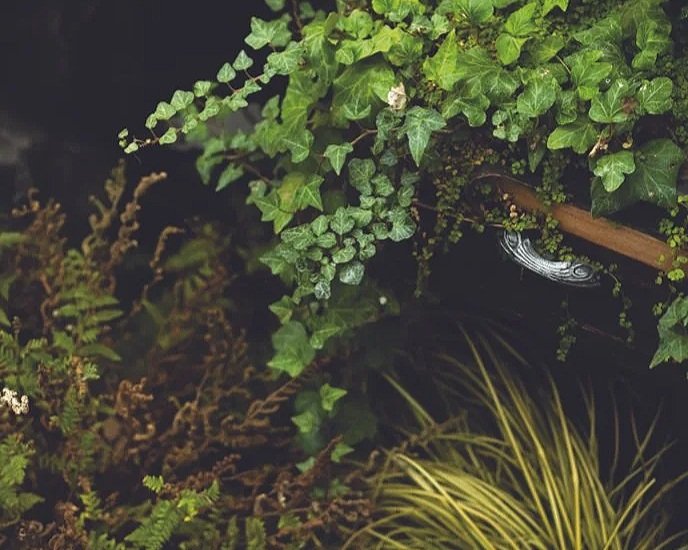
When ground space is limited, the key is to start thinking vertically. By using planting to climb up boundary fences and walls, you can transform a plain, sterile garden into a lush green space.
Climbing plants soften harsh boundaries and replace bare fencing or breeze block walls with a living backdrop. They also help the garden feel more enclosed and peaceful.
For shaded gardens, climbers such as variegated ivy and Trachelospermum jasminoides (star jasmine) work particularly well. They provide structure, evergreen coverage and a much more natural feel than fencing alone.
2. Improve Privacy with Pleached Trees and Green Screening
In Bristol and Bath gardens, privacy is one of the most common reasons people seek professional garden design. Overlooked gardens can feel exposed, especially in terraced streets or new-build developments.
A great solution is the use of pleached trees. Pleached hedging is trained on clear stems, meaning the leafy canopy sits higher up — providing privacy screening at window height, while leaving the space underneath free for planting, seating or pathways.
Pleached Elaeagnus, Ligustrum and Photinia are all popular evergreen choices depending on the look you want.
This type of screening instantly makes a garden feel more secluded, without taking up valuable floor space.
3. Add a Specimen Tree for Structure and a Focal Point
A well-chosen tree can completely change the feel of a small garden. Adding a specimen tree creates height, structure and a strong focal point, giving the garden a sense of maturity.
By “specimen” I mean a tree that stands alone and makes an impact — something sculptural or elegant that draws the eye.
Don’t be afraid to buy a more mature tree. Most of the canopy will sit higher up, meaning you still keep space beneath for planting, seating or storage.
Trees and hedges are also fantastic for wildlife, providing shelter for birds and helping create a safer habitat away from predators such as cats.
4. Keep Planting Simple and Focus on Foliage
One of the biggest mistakes in small garden planting design is using too many different plant types. In a compact space, a busy planting scheme can quickly feel messy and overwhelming.
Instead, keep your planting design simple by choosing a limited palette of plants and repeating them throughout the garden.
In shaded gardens especially, foliage becomes far more important than flowers. Many shade-loving plants don’t flower for long due to limited sunlight, so relying on blooms for colour often leads to disappointment.
A more successful approach is to use leaf shape, texture and contrast.
For example, combining bold foliage plants such as Fatsia japonica with softer textured grasses like Hakonechloa macra creates a lush woodland feel. Both thrive in shade and work beautifully in Bristol and Bath gardens where light levels are often reduced.
If you’d like help choosing the right plants for your garden, you can read more about my Planting Design service.
5. Use Only a Few Hard Landscaping Materials
The same rule applies to paving and landscaping. Too many materials in a small garden can make the space feel cluttered and disjointed.
Choose two or three hard landscaping materials and repeat them across the design. This creates a clean, cohesive look and helps the garden feel larger.
You can also turn one boundary into a feature wall using bold paint, timber slats, natural stone, or even a large outdoor mirror to reflect light and add depth. A feature wall gives the eye something to focus on, which helps stop the garden feeling like a box.
6. Think Bold — Don’t Cram Too Much In
A small garden works best when the design is bold and simple.
Rather than trying to squeeze in a lawn, a fire pit, a pond, raised planters and multiple seating areas, focus on one strong layout that works beautifully.
Often, the best solution is a generous paved seating area that can be used for dining, entertaining and relaxing, surrounded by layered planting. This makes the garden practical, spacious and easy to maintain.
In small garden design, less really is more.
Related reading
If you’d like to discuss your own garden, you’re welcome to get in touch here.